Querying a Black Box
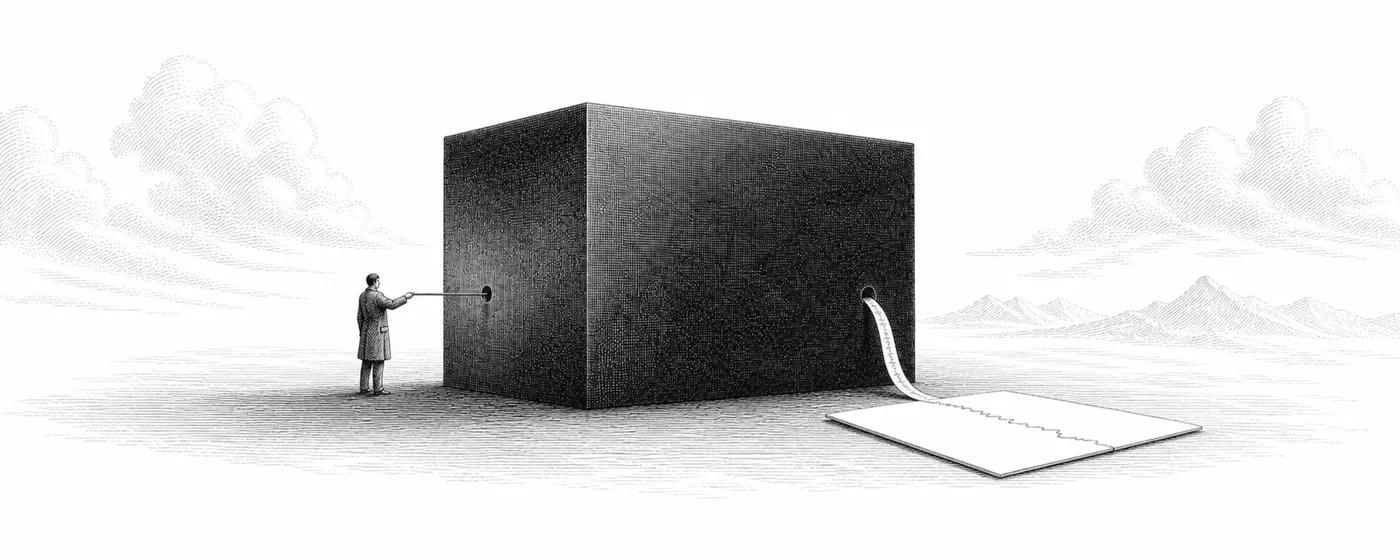
Some kinds of work are debugging a system whose source code exists. Other kinds are interrogating a system that has no source code at all, that you can only poke from the outside, that answers you through an instrument that may itself be lying. These two situations feel similar from the inside, both involve uncertainty, both involve careful reasoning toward a conclusion, but they are epistemically different in a way that explains almost everything about why automation works beautifully for one and treats the other like quicksand.
It is worth building the distinction slowly, because the philosophy that illuminates it is old, and the old version is sharper than the casual version that gets passed around.
Hume's problem, in its strong form
The induction problem is usually told softly: you have seen a thousand white swans, you cannot conclude the next is white. Told that way it sounds like a warning against overgeneralizing. Hume's actual version is much harder.
Why do you believe the future will resemble the past at all? Say "because the past has always resembled the past": that is itself an inductive inference, using induction to justify induction, circular. Say "because nature is uniform": and why believe nature is uniform? Only because it has been so far, which is induction again, circular again. Hume's conclusion is not that induction is somewhat unreliable. It is that induction has no rational justification, none. Every "the sun will rise tomorrow," every "this drug will still work next week," is, as a matter of logic, exactly as groundless as its denial. We make these inferences anyway, Hume says, not because we have a reason, but out of habit: a psychological fact, not a logical entitlement.
This matters because the entire enterprise of reasoning from data to conclusion rests on the step Hume dissolved. When you go from "in my sample, X and Y are associated" to "X and Y are really associated," there is no logical bridge. The work is not useless, but its validity was never the thing holding it up. Something else is. What that something else is, is what the next two centuries of philosophy argue about.
Popper's escape, and what it costs
Popper accepts that Hume won, induction has no logical justification, and says the mistake was thinking science runs on induction at all. It does not.
You can never verify a universal claim by observation, because the next observation might break it. But you can falsify it with a single counterexample. Verification and falsification are logically asymmetric: no number of white swans confirms "all swans are white," one black swan refutes it. So science is not the accumulation of supporting evidence until you are sure. It is the proposal of bold, falsifiable conjectures, and the attempt to kill them. What survives the attempt is provisionally kept. A theory's scientific status is not how much evidence supports it but whether it sticks its neck out: whether it says, in advance, what observation would prove it wrong.
There is a quiet, important consequence here. For a conjecture to have any falsifying power, the prediction must come before the evidence. State what you bet you will see, then look. If you look first, see the result, and then construct an explanation, you have not tested anything, because any result can be fit with some story after the fact, and a story that explains everything has been refuted by nothing. The temporal order is not bookkeeping. It is the whole difference between a test and a rationalization.
Why falsification is never clean
Popper is beautiful and incomplete, and the incompleteness has a name: the Duhem-Quine problem. When an experiment contradicts a theory, what exactly has been falsified?
A prediction is never derived from a theory alone. It comes from the theory plus a large cloud of auxiliary assumptions: the instrument works, the reagents are pure, the sample is clean, the statistical model is appropriate, that one confounder you never thought of is absent. When the result conflicts, logic tells you only that something in the whole bundle is wrong. It does not tell you which. So you can always rescue the theory you love by blaming an auxiliary: "must be the equipment, run it again." Falsification is never the clean single stroke Popper imagined. A black swan can always be explained away as "not really a swan" or "I misread."
In domains where the instruments are transparent, this rarely bites: when you read a variable in a debugger, the debugger does not lie, so a failed test usually means the code is wrong, and blame is locatable. But where the instrument is itself opaque, where the measuring apparatus is its own black box you don't fully understand, the blame for a contradiction cannot be cleanly assigned. You wanted to interrogate one black box, and your interrogation tool turned out to be another.
Map and territory
All of this rises to a single picture. Every model, every claim, every hypothesis is a map. The territory is the real world, existing independently of any map. Hume's problem, Popper's asymmetry, Duhem-Quine's undecidability, all of them flow from one fact: we only ever have access to maps comparing against maps. We never get to step outside all maps and grab the territory directly to check.
You want to verify a claim. With what? Another observation, which is itself a map, mediated by your instrument, your method, your conceptual frame. You are forever on the map side, and the territory intervenes only in a few places where it is forced to answer directly: the genuine experiment, and above all the experiment that puts a question to the irreducible complexity of the real world over real time. Those are the rare moments the territory talks back. Everywhere else, what you take for a fact is a map agreeing with a map.
The unifying frame: querying a black box
Put it together and the distinction at the start becomes precise. Some work is debugging a white box: a system with source code, whose state you can read directly, whose measurements are transparent. Other work is querying a black box: a system with no source code, that you cannot read but only perturb, whose every answer comes back through a noisy, possibly-deceptive instrument, and which never even promised that its underlying rules are simple or stable.
This one frame explains the whole asymmetry. Why one kind of work has a cheap verifier and the other does not: the white box's state can be read directly and compared, while the black box's state can only be perturbed and inferred through noise. Why automation soars on one and stalls on the other: querying the white box is instant, certain, infinitely repeatable; querying the black box is slow, noisy, and never exactly reproducible. Why plausibility is so dangerous in one and not the other: in the white box a plausible error is quickly exposed by transparent measurement, while in the black box a plausible error can hide forever behind "maybe it was the instrument." And why the deepest verifier is irreducible: to query the ultimate black box, the real world, in its full diversity, over real time, there is no cheaper query that substitutes, because every cheaper query is a different black box, separated from the real one by another map-territory gap that cannot be cleanly crossed.
The frame does not solve the problem. Nothing solves it; it is the structure of being on the map side. But it tells you what kind of problem you are in, which is the prerequisite for not lying to yourself about what your conclusions are worth. The discipline that follows is simple to state and hard to keep: never let "I have a map of it" pass for "I have touched the territory." The map can be excellent. The territory still has not spoken.
追问黑箱
有些工作,是在调试一个源代码可见的系统。另一些工作,则是在审问一个完全没有源代码的系统——你只能从外部去触碰它,它通过某种仪器给你回应,而那台仪器本身可能也在撒谎。这两种处境从内部感受上很相似:都充满不确定性,都需要缜密推理才能得出结论。但在认识论(epistemology)层面,它们有本质差异,而这一差异几乎能解释所有现象:为什么自动化在一种工作上如鱼得水,面对另一种却寸步难行。
这个区分值得慢慢展开来建立,因为能够照亮它的哲学已经很古老了,而古老的原始版本比流传中被简化的通俗版本更为锐利。
休谟的问题,强形式版本
归纳(induction)问题通常被温和地讲述:你见过一千只白天鹅,但不能由此断定下一只也是白的。这么讲,听起来不过是在告诫人们不要过度概括。但休谟(David Hume)的原始版本要严厉得多。
你凭什么相信未来会与过去相似?如果回答"因为过去一直与过去相似",这本身就是一个归纳推理——用归纳来为归纳辩护,循环论证。如果回答"因为自然是均匀的",那你又凭什么相信自然是均匀的?只因为到目前为止它一直如此——这又是归纳,又是循环。休谟的结论不是说归纳有些不可靠,而是说归纳没有任何理性依据,丝毫没有。每一句"太阳明天还会升起",每一句"这种药下周依然有效",就纯粹逻辑而言,与其否命题一样毫无根据。休谟说,我们之所以仍然做出这些推断,不是因为我们有理由,而是出于习惯:这是一个心理学事实,而非逻辑上的正当权利。
这一点至关重要,因为从数据到结论的整个推理事业,正是建立在休谟所瓦解的那一步之上。当你从"在我的样本中,X 与 Y 相关"跳到"X 与 Y 确实相关"时,其间没有逻辑桥梁。这项工作并非毫无用处,但支撑它的从来就不是它自身的有效性,而是某种别的东西。至于那个"别的东西"究竟是什么,接下来两个世纪的哲学一直在争论。
波普尔的突围,以及它的代价
波普尔(Karl Popper)承认休谟赢了——归纳没有逻辑依据——然后指出,真正的错误在于以为科学一开始就建立在归纳之上。其实不然。
你永远不可能通过观察来证实一个全称命题,因为下一次观察随时可能推翻它。但你可以凭一个反例将其证伪(falsification)。证实与证伪在逻辑上是不对称的:再多的白天鹅也无法确认"所有天鹅都是白色的",但一只黑天鹅就能驳倒它。因此,科学并不是积累支持性证据直到你确信无疑,而是提出大胆的、可证伪的(falsifiable)猜想(conjecture),然后竭力去推翻它们。经受住攻击而幸存的理论暂时被保留。一个理论的科学地位不在于有多少证据支持它,而在于它是否敢于把自己暴露在反驳之下:是否提前声明了什么样的观察能证明它是错的。
这里有一个安静但重要的推论。一个猜想要具有任何证伪力量,预测就必须出现在证据之前。先陈述你预期会看到什么,然后再去观察。如果你先看到了结果,再构造一个解释,那你其实什么也没检验——因为任何结果都可以在事后被某个故事所拟合,而一个能解释一切的故事实际上什么也没有被驳倒。时间顺序不是簿记细节,它是检验与合理化之间的全部分界线。
为什么证伪从来不是干净利落的
波普尔的方案优美却不完整,而这种不完整有一个名字:迪昂—蒯因问题(Duhem-Quine problem)。当一个实验与一个理论相矛盾时,究竟是什么被证伪了?
一个预测从来不是单独从一个理论推导出来的。它来自理论加上一大团辅助假设(auxiliary assumptions):仪器正常运转,试剂是纯的,样品没有污染,统计模型是合适的,那个你从未想到过的混杂因素(confounder)并不存在。当结果出现矛盾时,逻辑只告诉你整个假设束中有某处出了错,但不告诉你是哪一处。所以你总是可以通过归咎于某个辅助假设来挽救你心爱的理论:"一定是设备的问题,再跑一次。"证伪从来不是波普尔设想的那种干净利落的一击。一只黑天鹅总是可以被解释为"其实不是天鹅"或"我看错了"。
在那些仪器透明可查的领域里,这个问题很少造成真正的麻烦:当你在调试器中读取一个变量时,调试器不会对你撒谎,所以一个失败的测试通常意味着代码有错,责任可以被定位。但在那些仪器本身就是不透明的领域——测量装置自身就是一个你并不完全理解的黑箱(black box)——矛盾的责任就无法被干净地归结。你本想审问一个黑箱,结果发现你的审问工具本身又是另一个黑箱。
地图与疆域
上述一切汇聚为一幅统一图景。每一个模型、每一个命题、每一个假说,都是一张地图。疆域则是真实世界,独立于任何地图而存在。休谟的问题、波普尔的不对称性、迪昂—蒯因的不可判定性,它们全都源自同一个事实:我们永远只能用地图去比对地图,永远无法走出所有地图之外,直接抓住疆域来核验。
你想要验证一个命题。用什么来验证?用另一次观察——而那本身也是一张地图,经由你的仪器、你的方法、你的概念框架所中介。你永远处在地图这一侧,疆域只在少数几个地方被迫使直接作答:真正的实验,尤其是那些在真实时间中向真实世界的不可约简的复杂性提出追问的实验。那是疆域做出回应的罕见时刻。除此之外,你以为是事实的东西,不过是一张地图在与另一张地图相互印证。
统一框架:追问黑箱
将以上一切组合起来,文章开头的那个区分就变得精确了。有些工作是在调试一个白箱(white box):一个有源代码的系统,你可以直接读取其状态,其测量是透明的。另一些工作是在追问一个黑箱:一个没有源代码的系统,你无法读取只能从外部扰动,它的每一个回答都经过一台噪声重重、甚至可能具有欺骗性的仪器传递,而且它从未承诺过其底层规则是简单的或稳定的。
这一个框架就能解释整个不对称性。为什么一种工作拥有廉价的验证者(verifier)而另一种没有:白箱的状态可以被直接读取和比较,而黑箱的状态只能通过噪声被扰动和推断。为什么自动化在一种工作上一飞冲天、在另一种上却停滞不前:查询白箱是即时的、确定的、可无限重复的;查询黑箱是缓慢的、充满噪声的、且永远无法精确重现的。为什么似真性(plausibility)在一种工作中如此危险而在另一种中不然:在白箱中,一个看似合理的错误会被透明的测量迅速揭露;而在黑箱中,一个看似合理的错误可以凭借一句"也许是仪器的问题"永远藏身其后。以及为什么最深层的验证者是不可约简的:要追问那个终极黑箱——真实世界——以其全部多样性、在真实时间中展开,没有更廉价的查询可以替代,因为每一个更廉价的查询都是一个不同的黑箱,与真实的那个之间隔着又一道无法干净跨越的地图与疆域之间的鸿沟(map-territory gap)。
这个框架并不解决问题。没有什么能解决它;这就是身处地图一侧的结构性处境。但它告诉你你正身处何种问题之中,而这是不自欺于自己的结论到底值多少的前提条件。随之而来的纪律说起来简单,守起来很难:永远不要让"我有一张关于它的地图"冒充"我触碰到了疆域"。地图可以极其精良,但疆域仍未开口。