The Shape of Not Knowing
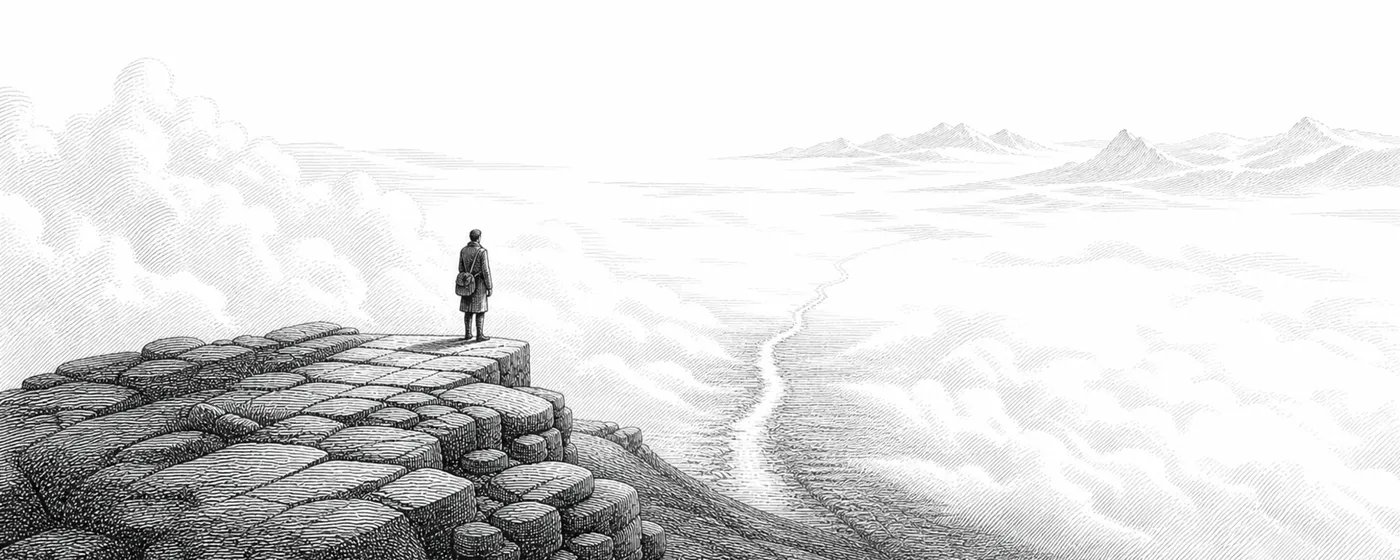
In 2002, answering a question about evidence linking Iraq, weapons of mass destruction, and terrorist organizations, Donald Rumsfeld sorted uncertainty into three kinds: the things we know we know, the things we know we do not know, and the things we do not know we do not know. The briefing transcript is worth reading in context; an elegant distinction can still be used inside a disastrous argument. But the distinction outlived the argument because it gives ignorance a shape.
Complete it into a two-by-two matrix and a fourth category appears:
| Awareness | I know it | I do not know it |
|---|---|---|
| I am aware of it | I know that I knowknown known | I know that I do not knowknown unknown |
| I am not aware of it | I do not know that I knowunknown known | I do not know that I do not knowunknown unknown |
The top row is easy to discuss. A known known can be stated. A known unknown can at least be asked. Ordinary question answering is built for these two cells: give the system a proposition or a gap, and ask it to confirm or fill it.
The bottom row is where conversation gets interesting. It contains what I cannot simply type into a prompt. I may possess a distinction without having words for it. I may be missing an entire region of possibility and therefore lack even the question that would reveal it. These two failures look equally blank from the outside, but they require opposite kinds of help.
A map is not an inventory
There is a paradox in putting unknown unknowns on a map. The moment I can name one, it is no longer wholly unknown. At best I can mark a frontier: there is probably something in this region that my present vocabulary and model do not expose.
This is why the matrix should not be treated as a complete inventory of mental contents. It is an orientation device. It says where the next conversational move should point, not everything waiting to be found there.
The distinction matters because a bad map of ignorance creates a peculiar kind of overconfidence. A list of known unknowns feels comprehensive precisely because everything outside the list is absent. The map becomes useful only when one of its symbols means not “miscellaneous unanswered questions,” but “the frame itself may be missing something.”
That makes the fourth cell, the unknown known, equally important. It prevents us from treating whatever was not stated as whatever was not known.
We know more than we can tell
Michael Polanyi built The Tacit Dimension on one blunt sentence: “we can know more than we can tell.” The line is often reduced to know-how: riding a bicycle, recognizing a face, sensing that an argument is wrong before locating the broken step. But its force is broader. Articulation is not a transparent export operation that copies already explicit knowledge from the mind into language. Some knowledge exists first as skilled discrimination, attention, timing, or recognition.
You can see this in aesthetic judgment. Someone says a transition feels cheap. Ask what easing curve they want and they cannot answer. Show them linear motion, ease-out, spring motion, and a staggered entrance, each attached to a tiny scene, and the answer may be immediate. Nothing was retrieved by recall. A vocabulary was offered, and recognition selected from it.
This is one species of unknown known: not a secret proposition hidden intact in the mind, but a capacity that becomes legible when the right contrast appears. The correct conversational move is therefore not another blank question. “Tell me what you want” merely repeats the demand the person cannot satisfy. The useful move is to lend words: offer a small set of named distinctions, make each concrete enough to feel, and let the person point, reject, or revise.
Tacit knowledge does not exhaust the unknown-known cell. Unexamined habits, inherited categories, bodily warnings, and assumptions a person has never needed to state can live there too. Polanyi is not a definition of the quadrant. He explains why the quadrant cannot be collapsed into ordinary missing information.
Meaning arrives in use
An earlier line of thought comes from Ludwig Wittgenstein. I place him after Polanyi here because the essay follows the problem, not the calendar: Philosophical Investigations appeared before The Tacit Dimension. If a word's meaning were a private object stored behind it, then finding the right word would mean matching a label to that hidden object. Wittgenstein's later philosophy instead turns attention toward use. The Stanford Encyclopedia of Philosophy summarizes the movement in the Philosophical Investigations from meaning as representation toward meaning as use: look at the activities in which a word does work, the contrasts it draws, and the judgments it makes possible.
This is why an example matters more than a synonym. “Spring easing” becomes useful when it is placed in a miniature language-game: a panel overshoots its resting point, returns, and feels as if it has mass. The scene is not decoration around the definition. It is part of how the expression acquires grip.
Wittgenstein's discussion of aspect-seeing goes one step further. In the duck-rabbit illusion, the marks on the page do not change when perception changes from duck to rabbit. What changes is the aspect under which they are seen.
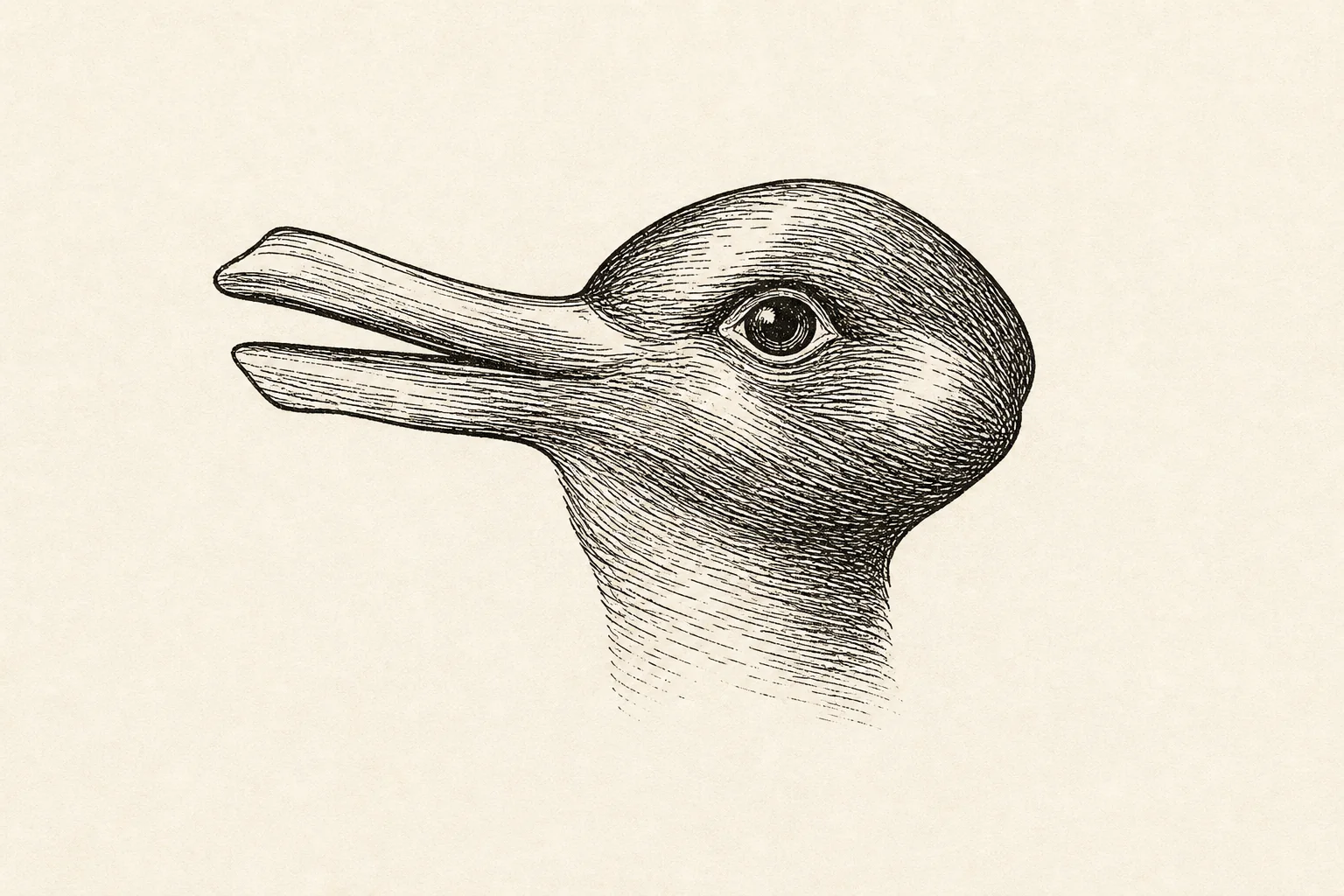
Later commentary connects this idea of seeing an aspect with seeing a meaning. That is close to what a productive conversation often does. It does not merely add another fact. It makes an existing situation newly nameable, visible, or testable.
I do not mean that Polanyi, Wittgenstein, and the Rumsfeld matrix form a hidden unified theory. They do not. The connection is an engineering one. The matrix identifies where a conversation is stuck. Tacit knowing explains why asking for explicit recall may fail. Meaning-in-use and aspect-seeing suggest how examples, contrasts, and probes can change what the user is able to recognize and say.
The two dark cells need opposite help
Suppose I know what I like but cannot describe it. The answer is already constrained by my experience. I need candidates rich enough to recognize. This is the unknown known, and the move is: lend words.
Suppose instead that I am entering a field whose important options I have never encountered. No candidate is waiting inside me to be recognized. Asking me which architecture, research design, or career path I prefer only makes me choose among the few names I happened to bring. This is the unknown unknown, and the move is: give a tour. Show me the nearby option space, what each region is for, what it costs, and which direction you think fits.
The distinction is practical:
- For an unknown known, recognition beats recall.
- For an unknown unknown, orientation must come before preference.
The other two cells also imply moves. Confirm and compress what is already settled; do not let it occupy the whole conversation. Investigate a named gap by identifying what evidence, reasoning, or experiment would resolve it; when that probe is cheap enough to run, run it rather than asking the user to speculate in its place. A four-cell map should produce four behaviors, not merely four labels.
And the behaviors cannot be a closed list. Taste articulation, capability discovery, and open decisions are useful examples, but they are not the boundaries of the method. Another topic may require exposing an assumption, changing scale, offering a counterexample, drawing a distinction, or running a premortem. The common action is aspect-seeing: make one relevant part of the subject more nameable, visible, or testable.
A conversation should leave a trace
Once the matrix becomes a discussion method, it needs state, and the state must stay cheap to redraw: a fixed skeleton, one phrase per entry, a card rather than a document. A map that outgrows a glance stops being redrawn, and a map that is not redrawn stops being state. Within the card, I use four marks:
✓settled?a named question!a recognition candidate~an unexplored frontier
These are not confidence scores. They describe what kind of work remains. A ? can be answered or explicitly deferred. A ! can be recognized, rejected, or refined. A ~ cannot be “solved” in the exhaustive sense; it can be explored into something more concrete or honestly retained as residual darkness.
That last possibility matters. A conversation that converts every mark to ✓ has probably confused closure with omniscience. Before closing, it should attempt one frame-break: name a plausible missing aspect that, if real, would change the conclusion. If it matters, keep going. If it does not, preserve it as a boundary rather than manufacture an answer.
The final artifact should not be the map itself. The map is a receipt: it shows how the discussion moved. What the user leaves with should be a brief: the vocabulary they recognized, the choices they settled, the gaps they deferred, and the darkness that remains, written so it can be pasted into a future conversation without reconstructing the entire path.
Turning the idea into a skill
I encoded this method as an open-source agent skill called known-unknowns.
It gives an agent a simple discipline. Open by drafting the whole map at once, from the topic and whatever domain knowledge applies, with every inference tagged as a guess. This sounds presumptuous, and that is the point: a wrong map draws corrections faster than a blank interview draws answers. Then work one cell per turn, entering wherever the map is darkest but still useful. Contribute before asking: lend vocabulary, tour an option space, run the probe a named gap allows, test an assumption, or choose another move that creates an aspect-seeing. Ask exactly one question. Redraw the map on the next turn, so anything the user recognized or corrected becomes part of the visible state.
The constraint is deliberately conversational. A blank interview offloads all the work onto the person who came because they did not yet have the words or the map. An unbroken lecture fills space without letting recognition steer. One contribution followed by one question creates a narrower loop: the agent supplies structure, the user supplies correction, and the map changes.
There is no promise that this discovers every unknown unknown. Such a promise would contradict the point of the matrix. The skill does something smaller and more useful: it refuses to treat silence as emptiness, and it gives a discussion a repeatable way to approach what cannot yet be asked.
无知的形状
2002 年,唐纳德·拉姆斯菲尔德(Donald Rumsfeld)在回答一个有关伊拉克、大规模杀伤性武器与恐怖组织之间证据关联的问题时,把不确定性分成了三类:我们知道自己知道的事,我们知道自己不知道的事,以及我们不知道自己不知道的事。那场记者会的文字记录值得放回语境中阅读;一个精巧的区分,仍然可能被用在一套灾难性的论证里。但这个区分活得比那套论证更久,因为它让无知有了形状。
把它补成一个二乘二矩阵,第四类便浮现出来:
| 觉察状态 | 我知道 | 我不知道 |
|---|---|---|
| 我已经意识到 | 知道自己知道known known | 知道自己不知道known unknown |
| 我尚未意识到 | 不知道自己已经知道unknown known | 不知道自己不知道unknown unknown |
上面一行很容易讨论。知道自己知道的内容可以直接陈述;已经意识到的知识缺口至少可以变成一个问题。普通的问答系统正是为这两格设计的:给系统一个命题或一道缺口,让它确认前者或填补后者。
真正让对话变得有意思的是下面一行。那里装着我无法直接打进提示词里的东西。我可能已经掌握了一个区分,却没有描述它的词;也可能漏掉了一整片可能性,因而连揭开它的问题都无从提出。从外面看,这两种失败同样是一片空白,但它们需要的帮助恰好相反。
地图不是清单
把“尚未意识到自己不知道的事”放上地图,本身就有一个悖论:当我能够指名某一项时,它已经不再完全未知。我最多只能标下一条前沿:这个区域里大概还有些东西,是我现有的词汇和模型照不出来的。
所以,这个矩阵不该被当成一份完整的心智内容清单。它是一种定向工具。它告诉我们下一步对话应该朝哪里走,而不是宣称那里等待着被发现的一切都已经列全。
这个区别很重要,因为一张糟糕的无知地图会制造一种古怪的过度自信。已经意识到的知识缺口看起来很全面,恰恰是因为列表之外的一切都没有出现。只有当地图上有一个符号不再表示“其他尚未回答的问题”,而是表示“框架本身可能漏了东西”,这张地图才真正有用。
这也让第四格(那些尚未意识到自己已经知道的东西)变得同样重要。它阻止我们把“没有说出来”直接等同于“不知道”。
我们知道的,比能说出的更多
迈克尔·波兰尼(Michael Polanyi)把整本 The Tacit Dimension(可译作《默会维度》)建立在一句朴素的话上:“我们知道的,比能说出的更多。”这句话常被缩减成“诀窍”:骑自行车、辨认一张脸,或者在还找不到断裂步骤之前,先感觉到一段论证不对。但它的力度更广。表达并不是一种透明的导出操作,不会把心中早已显式存在的知识原样复制进语言。有些知识首先以熟练的辨别力、注意方式、时机感或识别能力存在。
审美判断里很容易看到这一点。有人说一个转场显得廉价。你问他想要哪一种缓动曲线,他答不上来。但如果把线性运动、缓出、弹簧运动和错落入场分别配上一小段具体场景展示给他,答案也许立刻就会出现。这里不是靠回忆把答案取出来,而是先由对话提供一组词,再由当事人的识别判断哪一个贴切。
这是“不知道自己已经知道”的一种情形:它不是一条完整藏在心里的秘密命题,而是一种能力,在恰当的对照出现时才变得清晰可读。因此,正确的对话动作不是再抛出一个空白问题。“告诉我你想要什么”,只是重复要求对方完成他眼下无法完成的事。更有用的动作是借出词语:给出一小组有名字的区分,让每一个都具体到足以被感受到,再让对方指认、拒绝或修正。
默会知识并不穷尽这一格。未经审视的习惯、继承而来的范畴、身体发出的警报,以及一个人从来不需要说出口的假设,也可能住在这里。波兰尼不是这一个象限的定义。他解释的是,为什么这一格不能被压扁成普通的信息缺口。
意义在使用中到来
另一条时间上更早的线索来自路德维希·维特根斯坦(Ludwig Wittgenstein)。本文把他放在波兰尼之后,是因为论述按问题推进,而不是按年代排序:Philosophical Investigations(《哲学研究》)早于 The Tacit Dimension 出版。如果词语的意义是藏在背后的某个私人对象,那么找到正确的词,就等于为那个隐藏对象配上标签。维特根斯坦后期的哲学转而把注意力投向使用。《斯坦福哲学百科全书》(Stanford Encyclopedia of Philosophy)把《哲学研究》中的转向概括为:从意义即表征,转向意义即使用。去看一个词在哪些活动里真正发挥作用,它划出了什么对照,又让哪些判断成为可能。
因此,一个例子往往比一个同义词更重要。“弹簧缓动”只有进入一个微型语言游戏后才真正有用:一块面板冲过终点,回弹,然后让人感觉它仿佛有了质量。这个场景不是定义之外的装饰;正是在这样的使用中,这个表达才变得可理解、可运用。
维特根斯坦对面相观看(aspect-seeing)的讨论又往前走了一步。鸭兔图(duck-rabbit illusion)是一张可以稳定读成两种动物的双义图:图没有变,知觉却可以在鸭子与兔子之间切换;改变的是我们观看同一组线条的面相。
后来的研究把看见一个面相与看见一种意义联系起来。这很接近一场富有成效的对话经常做的事:它不只是再添加一个事实,而是让已有的处境变得可以重新命名、看见或检验。
我并不是说波兰尼、维特根斯坦与拉姆斯菲尔德矩阵组成了某种隐藏的统一理论;并非如此。我所做的是一次工程上的嫁接。矩阵指出对话卡在哪里;默会认识解释为什么要求直接回忆可能失败;意义即使用与面相观看则提示我们,例子、对照和探针如何改变用户能够识别和说出的东西。
两个暗格需要相反的帮助
假设我知道自己喜欢什么,却无法描述。答案已经被我的经验约束,只是我需要足够鲜明的候选项来识别。这属于“不知道自己已经知道”,对应的动作是:借出词语。
再假设,我刚进入一个陌生领域,连其中重要的选项都没遇见过。此时我心里并没有一个等待识别的候选答案。问我更喜欢哪一种架构、研究设计或职业路径,只会迫使我从碰巧带来的那几个名字里挑选。这属于“不知道自己不知道”,对应的动作是:带路。带我看一遍附近的选项空间,每个区域适合做什么、代价是什么,以及你认为哪个方向更适合我。
这个区分非常实际:
- 面对那些还说不出来、但已经能够识别的知识,识别优于回忆。
- 面对尚未进入视野的未知,必须先定向,才能谈偏好。
另外两格也各有动作。对于已经确定的内容,确认并压缩,不要让它占满整场对话。对于已经点名的缺口,找出需要什么证据、推理或实验才能解决;如果这个探针当下就能执行,就先执行它,而不是让用户凭空猜测答案。四格地图应该产生四种行为,而不只是四个标签。
这些行为也不能变成一份封闭清单。说清审美偏好、发现能力边界、权衡开放决策,都是很有用的例子,却不是这套方法的边界。另一个话题也许需要暴露假设、切换尺度、给出反例、划出区分,或者做一次事前验尸(premortem)。它们共有的动作是 aspect-seeing:让主题中一个相关的部分变得更可命名、可看见或可检验。
对话应该留下痕迹
当矩阵变成一种讨论方法,它就需要状态,而状态必须轻到每一轮都能重画:固定的骨架,每格一句话,是一张卡片,不是一份文档。一张膨胀到无法一眼看完的地图不会再被重画,而不再被重画的地图,也就不再是状态。在这张卡片里,我使用四个标记:
✓已经确定?已经点名的问题!待识别候选项~未探索前沿
它们不是置信度分数,而是在说明还有哪一类工作没有完成。一个 ? 可以得到回答,也可以被明确推迟;一个 ! 可以被识别、拒绝或修正;一个 ~ 无法在穷尽意义上被“解决”,只能在探索中变成一个问题、候选项或已经确定的内容,或者被诚实地保留为残余暗区。
最后一种可能尤其重要。一场把所有标记都改成 ✓ 的对话,很可能把收尾误当成了全知。结束之前,它应该做一次破框检查(frame-break):提出一个可能被遗漏的面相,并检验它一旦成立是否足以改变结论。如果确实重要,就继续;如果没有那么重要,就把它保留为边界,而不是制造一个答案。
最终产物不该是地图本身。地图是收据,记录讨论如何移动;用户真正带走的,应该是一份简报(brief):识别出的词汇、已经确定的选择、明确推迟的缺口,以及仍然存在的暗区,写到可以直接粘进下一场对话、不必重建整条路径的程度。
把想法写成一个 Skill
我把这套方法编码成了一个开源智能体 Skill,叫作 known-unknowns。
它给智能体加上一条简单的纪律。开场就把整张地图一次画出来:依据话题和自己掌握的领域知识填满四格,并把每一处推断都明确标成猜测。这听起来有些冒失,而这正是用意所在:一张画错的地图,比一场空白访谈更快引来纠正。此后每轮只处理一格,从最暗但仍然有用的那格进入。先贡献,再提问:借出词语、带着用户巡视选项空间、执行一个已点名缺口所允许的探针、检验一项假设,或者选择另一个能够触发 aspect-seeing 的动作;然后只问一个问题。下一轮重画地图,让用户刚刚识别或纠正的内容进入可见状态。
这套约束刻意保持了对话性。空白式访谈会把全部工作重新丢给那个前来求助的人,而他来这里,恰恰是因为还没有词,也没有地图。不中断的讲授则会填满空间,却不给识别留下转向的机会。一次贡献,接一个问题,会形成更窄的循环:智能体给出结构,用户负责纠偏,地图随之改变。
它不承诺发现所有尚未进入视野的未知。这样的承诺本身就违背了矩阵的意义。这个 Skill 做的是一件更小、也更有用的事:它拒绝把沉默当成空无,并为讨论提供一种可重复的方法,去接近那些尚且无法被问出的东西。